Pumps play a key role in industrial systems and play a key role in many industries, including power plants, oil and gas, petrochemical, mining, water and wastewater treatment, and food processing. The stable and reliable operation of pumps ensures the quality, safety and efficiency of production processes. Two basic principles of pump design and operation are reliability and repeatability .
These two concepts help the industry reduce the risk of equipment failure, production downtime, and maintenance costs. This article looks at the importance of reliability and redundancy in pump systems, how to improve them, and their applications.

How reliable is the pump?
Reliability is the probability that a device will function properly under certain conditions and for a certain period of time. For a pump, reliability means that it pumps fluids properly without breakdowns or downtime.
Factors Affecting Pump Reliability
-
Design and construction quality : Choose the right materials for fans, shafts, bearings and seals.
-
Operating conditions : The pump operates within its Best Efficiency Point (BEP) range.
-
Proper lubrication and cooling systems .
-
Vibration control and balancing of rotating components .
-
Preventive and predictive maintenance .
High reliability means less unplanned downtime, longer service life and lower maintenance costs.
What is repetition?
Redundancy refers to the use of additional or backup devices in a system to prevent the failure of the entire system if one of the devices fails or is disconnected. In pump systems, redundancy is often achieved through backup pumps or parallel connections.
Pump Repeat Type
-
N+1 redundancy: In this configuration, an additional backup pump is installed for each N pump.
For example, if a process requires three pumps, a fourth backup pump is installed. -
100% Backup Mode
: In this mode, each main pump has a similar, fully functional pump as a backup. -
Parallel operation:
Two or more pumps work at the same time, so that if one pump fails, the other pumps compensate for the loss of power. -
Hot and cold waiting
-
Hot Standby : The circuit has a standby pump that starts working immediately after the main pump shuts off.
-
Cold Standby Mode : The standby pump is turned off and turned on only when needed.
The Importance of Pump Reliability and Repeatability
1. Ensure process reliability
In sensitive industries such as power plants or refineries , a pump failure can lead to safety incidents, explosions or environmental pollution. A high level of redundancy and reliability reduces the risk of these problems.
2. Reduction of costs associated with production interruptions
A sudden shutdown of a production pump can cause significant financial losses. A backup pump can prevent a complete standstill.
3. Extending the life of the equipment
When pumps are designed and maintained for high reliability, wear is reduced and service life is extended.
4. Improve service quality
In water and wastewater systems or municipal systems , ensuring continuous pump operation increases customer satisfaction.

Solutions to improve pump reliability
-
Select the right pump according to the process conditions.
-
Depending on the fluid type and operating conditions, select the appropriate capacity, height, and material.
-
Detailed planning of piping systems
-
The basic design is designed to reduce cavitation and hydraulic shocks.
-
Use of Condition Monitoring Equipment
-
Monitor vibration, temperature, pressure, and flow to predict failures.
-
Preventive and corrective maintenance
-
Perform regular maintenance and replace seals and bearings in a timely manner.
-
Use of new technologies
-
Use smart pumps and automatic control systems to prevent operation outside of design limits.
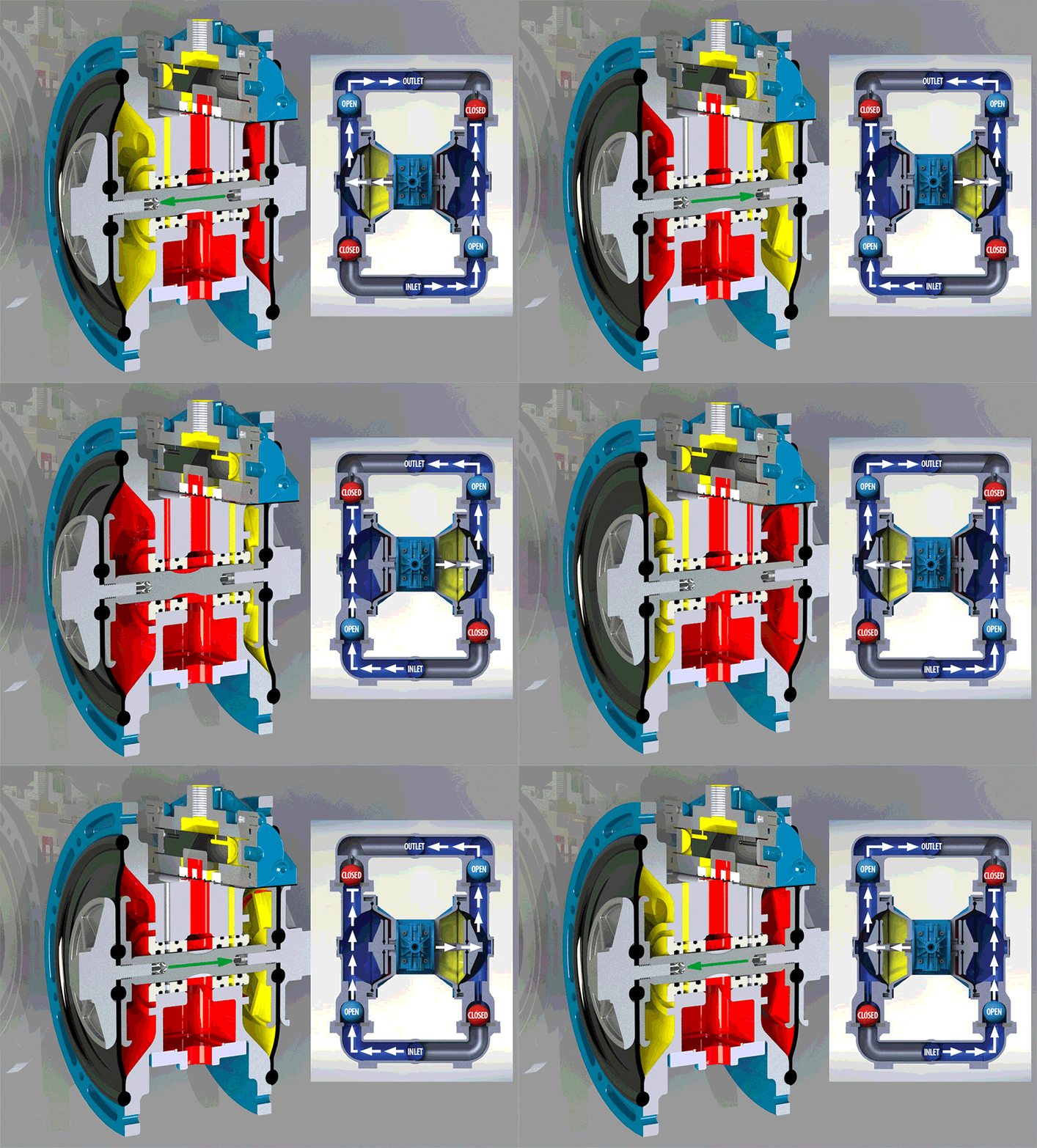
Redundancy solutions in the pump system
-
Install backup pumps in critical locations such as oil terminals, municipal water systems, and power plant cooling systems.
-
Use an automated system to automatically switch between primary and backup pumps.
-
The optimal scheme (N+1 or 100% reserve) is selected taking into account the sensitivity of the process and the investment costs.
-
Check the backup pump regularly to ensure that it is working properly in an emergency.
Comparison of reliability and repeatability
While these two concepts are different , they complement each other:
-
Reliability aims to reduce the probability of failure.
-
The aim of redundancy is to minimise the consequences of failures that occur.
In other words, high reliability reduces the likelihood of pump failure, and redundancy ensures that the process is not stopped even in the event of a failure.
Industrial examples
-
Power Plants : Boiler feed pumps are often installed in an N+1 configuration to avoid shutting down the power plant.
-
Oil and gas industry: Crude oil transfer pumps on long pipelines are always equipped with a standby pump.
-
Water treatment plants : To ensure the municipal water supply, replacement pumps must be provided so that the supply is not interrupted in the event of a failure.
The Future of Pump Reliability and Repeatability
With the advent of digital technologies, the Internet of Things and artificial intelligence, it has become possible to monitor the condition of pumps in real time . Smart systems can analyze data, predict potential failures, and even activate emergency pumps before an outage occurs.
The trend nowadays is towards the use of independent pumps with a safety function that automatically switches between the main and reserve pumps in the event of a problem.
At last
Reliability and redundancy are two important principles in the design, operation, and maintenance of pumps. Increased reliability means a lower failure rate and longer asset life, while redundancy ensures continuity of operations even in the event of failure .
In key industries such as power plants, oil and gas, and water and wastewater treatment, the combination of both approaches can significantly improve system safety and stability while reducing costs. The future of pumps also depends on the use of intelligent digital systems that improve reliability and redundancy management.